 Alex Morgan
About 70% of adults in the U.S. will experience at least one traumatic event in their lifetime, according to the National Council for Behavioral Health. Most will eventually process it and move on. But roughly 20% of those people develop PTSD, and here’s where almost every overview article fails them: they list “trauma therapy” as the answer, which is about as useful as telling someone with a broken leg to “see a doctor.” The type of therapy matters enormously, and the evidence gap between the best and the rest is not small.
I’ve spent years helping people find the right clinical match after a trauma diagnosis, and the mistake I see most often isn’t people avoiding therapy. It’s people trying the wrong therapy for months, deciding “therapy doesn’t work,” and giving up. That’s a preventable tragedy.
The current research picture, as of July 2026, is clearer than it’s ever been. Two approaches sit at the top of every major clinical guideline: Prolonged Exposure (PE) and Cognitive Processing Therapy (CPT). Everything else is either adjunctive, less studied, or better suited to specific subtypes of trauma or specific populations. Let’s get into what actually separates them.
- Prolonged Exposure (PE) and Cognitive Processing Therapy (CPT) have the strongest evidence base for PTSD among all current approaches.
- A 2019 JAMA Psychiatry meta-analysis found PE reduced PTSD symptom severity by an average of 51% compared to control conditions.
- Most evidence-based PTSD protocols run 8-15 sessions; expecting results in 2-3 sessions is a common mismatch in expectations.
- EMDR has solid evidence for single-incident trauma but shows more variable results in complex, repeated-trauma cases.
- Cost ranges from $0 (VA programs, community mental health) to $300+ per session out-of-pocket; insurance and sliding-scale options exist across all income levels.
The Two That Actually Work Best
Prolonged Exposure was developed by Dr. Edna Foa at the University of Pennsylvania and has been studied in randomized controlled trials since the 1990s. The core idea is counterintuitive to most trauma survivors: you approach the memory instead of avoiding it, repeatedly, in a structured way, until the brain learns the memory itself isn’t dangerous. A 2019 meta-analysis published in JAMA Psychiatry found PE reduced PTSD symptom severity by an average of 51% versus control conditions across 28 trials. That’s not a marginal effect. That’s the kind of number that should make you sit up.
CPT, developed by Dr. Patricia Resick, takes a slightly different angle. Less exposure to the raw memory, more examination of the beliefs the trauma created. “It was my fault.” “The world is completely dangerous.” “I can never trust anyone.” Trauma doesn’t just create fear; it creates false conclusions, and CPT targets those directly. A 2017 study in JAMA Psychiatry found CPT produced clinically significant improvement in 60% of veterans with combat-related PTSD after 12 sessions, a population notoriously hard to treat.
Which one is better? Honestly, the research is close enough that your preference matters more than any head-to-head data. Some people find PE’s direct memory-processing brutal but fast. Others find CPT’s structured worksheets steadying. I’ve seen people drop out of PE because they weren’t ready to confront the memory directly, then do incredibly well in CPT six months later. The answer is often “the one you’ll actually complete.”
Where EMDR Fits (And Where It Doesn’t)
Helpful resource: Get Out of Your Mind and Into Your Life (ACT Workbook) is a top-rated option for this. (As an Amazon Associate this site earns from qualifying purchases.)
Eye Movement Desensitization and Reprocessing gets a lot of attention, some of it warranted and some not. EMDR is genuinely effective, particularly for single-incident trauma: a car accident, a specific assault, a one-time medical emergency. The World Health Organization currently recommends it as a first-line treatment alongside trauma-focused CBT, and I don’t disagree for those cases.
But here’s the thing most articles won’t tell you: the evidence for EMDR in complex PTSD (C-PTSD), which often results from prolonged childhood abuse, domestic violence, or repeated institutional trauma, is noticeably thinner. A 2021 review in European Journal of Psychotraumatology found effect sizes for EMDR in complex presentations were smaller and less consistent than in single-incident populations. If your trauma is a pattern that lasted years, not a single event, EMDR might be part of a treatment plan, but it probably shouldn’t be the whole plan.
One detail that only comes up after you’ve actually sat in on EMDR sessions: the bilateral stimulation (the eye movements, or taps, or tones) doesn’t feel like much from the outside, but clients consistently describe the processing as disorienting in a way that’s hard to prepare for. Good EMDR therapists front-load stabilization skills before any memory work begins. If a provider wants to jump straight to memory processing in session one, that’s a red flag.
Comparing the Main Evidence-Based Options
Here’s a honest side-by-side so you’re not relying on brochure descriptions.
| Therapy | Best Evidence For | Typical Session Count | Format | Homework Involved? | Avg. Cost/Session (out-of-pocket) |
|---|---|---|---|---|---|
| Prolonged Exposure (PE) | Single/multiple-incident PTSD, veterans, assault survivors | 8-15 | Individual | Yes, significant (daily recording, in-vivo exposure tasks) | $150-$300 |
| Cognitive Processing Therapy (CPT) | PTSD with strong guilt/shame beliefs, veterans, sexual trauma | 12 sessions (structured protocol) | Individual or group | Yes, written worksheets | $150-$300 |
| EMDR | Single-incident trauma, phobia-adjacent PTSD | 6-12 | Individual | Minimal formal homework | $150-$250 |
| Trauma-Focused CBT (TF-CBT) | Children and adolescents (ages 3-18), caregiver involvement | 12-25 | Individual + family | Yes | $120-$250 |
| Seeking Safety | PTSD + co-occurring substance use | 25 (flexible) | Group or individual | Moderate | $50-$150 (often group-based) |
| Internal Family Systems (IFS) | Complex/developmental trauma | Open-ended (20-50+) | Individual | Varies by therapist | $150-$350 |
The cost ranges above reflect out-of-pocket private pay rates current as of July 2026. VA services, Federally Qualified Health Centers, and sliding-scale community clinics can bring per-session costs to zero or near zero for qualifying individuals.
Real Cases, Real Outcomes
A 34-year-old ER nurse sought therapy 18 months after a mass casualty event at her hospital. She had tried four sessions of general supportive therapy, felt “heard” but unchanged, and was about to quit.
Referral to a CPT specialist who recognized her dominant symptom cluster as self-blame and distorted responsibility beliefs → 12 structured CPT sessions → at follow-up, PCL-5 score dropped from 52 (severe) to 18 (below clinical threshold). She returned to full clinical hours within four months of completing treatment.
A 19-year-old college student with a single-incident sexual assault, no prior trauma history, presenting with classic avoidance and hyperarousal, minimal dissociation.
Matched to a PE-trained therapist who moved to imaginal exposure by session four → completed 10 sessions → CAPS-5 interview showed a 63% reduction in total symptom severity. She reported the homework was “the worst part and also why it worked.”
A 42-year-old veteran with 14 years of service, multiple deployments, childhood abuse history, presenting with complex symptom picture including dissociation and emotional dysregulation.
Single-modality PE attempted first, discontinued at session five due to destabilization → referred to a therapist trained in Phase-Based Treatment (stabilization first, trauma processing second) using elements of IFS and Seeking Safety → three years of treatment, slower, less dramatic, but sustained functional improvement. This case is important because it’s a reminder that the “gold standard” protocol can cause harm if applied to the wrong presentation.
What to Actually Ask When Choosing a Therapist
Don’t ask “do you do trauma therapy.” That means nothing. Ask specifically: “Are you trained in PE, CPT, or EMDR, and did you complete a formal training program or consultation process for that modality?” Most legitimate training programs, like the CPT certification program through the CPT for PTSD website, or PE training through the Center for the Treatment and Study of Anxiety, require supervised practice hours, not just a weekend workshop.
Ask how many PTSD clients they’ve treated with this specific approach in the past year. If the answer is one or two, that’s useful information. It doesn’t disqualify them, but it should factor in.
The National Alliance on Mental Illness (NAMI) maintains a helpline and can help with referrals if you’re not sure where to start. If you’re in acute distress, the 988 Suicide and Crisis Lifeline is available 24/7 and can also help connect you with local mental health resources.
One more thing: if you’re doing your own preparatory work between or before sessions, CBT-based workbooks can be genuinely useful as a supplement. Claudia Zayfert and Carolyn Black Becker’s Cognitive-Behavioral Therapy for PTSD: A Case Formulation Approach is written for clinicians but accessible to motivated readers. For something more self-directed, the PTSD Workbook by Mary Beth Williams and Soili Poijula offers structured exercises drawn from evidence-based approaches. (Disclosure: the site may earn a commission on Amazon purchases.)
Sources
- American Psychological Association (APA): Clinical Practice Guideline for PTSD (2017, updated recommendations current through 2026)
- Foa EB et al., JAMA Psychiatry (2019): Meta-analysis of Prolonged Exposure trials showing 51% average symptom reduction vs. control
- Resick PA et al., JAMA Psychiatry (2017): CPT in veterans; 60% clinically significant improvement at 12 sessions
- World Health Organization: Guidelines for the Management of Conditions Specifically Related to Stress (2013, reaffirmed 2022), recommending PE, CPT, and EMDR as first-line PTSD treatments
- Karatzias T et al., European Journal of Psychotraumatology (2021): Comparative review of EMDR and trauma-focused CBT in complex PTSD presentations
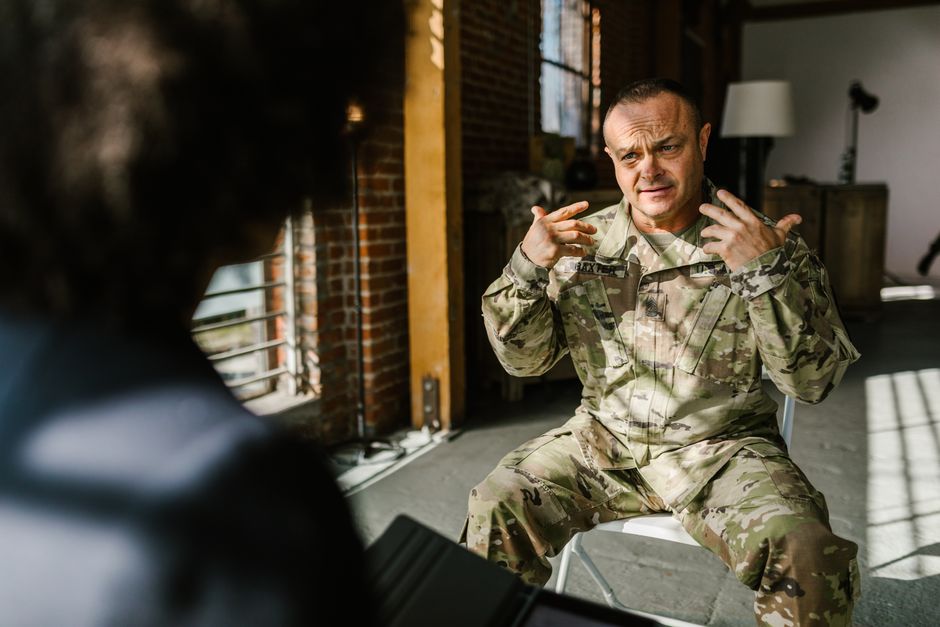
Photo: www.kaboompics.com via Pexels
This article is for general informational purposes only and does not constitute mental health, medical, or clinical advice. If you are in crisis or experiencing a mental health emergency, please contact the 988 Suicide and Crisis Lifeline (call or text 988) or go to your nearest emergency room. Always consult a licensed mental health professional for care specific to your needs.
Recommended Resources
Disclosure: As an Amazon Associate, we earn a small commission from qualifying purchases at no extra cost to you. We only recommend products that genuinely support the topics covered in this article.
- Feeling Good: The New Mood Therapy (~$14), The most clinically studied self-help book for depression, recommended by therapists worldwide as CBT-based self-treatment.
- Depression & Anxiety Therapy Journal (~$10), 8-week guided journal with trigger tracking and mood diary, mirrors the homework your therapist would assign between sessions.