 Dr. Chris Peterson
The honest answer is: sometimes. That’s not the hedge you’ll find in most articles about marriage counseling, which tend to land somewhere between cautious optimism and outright cheerleading. But vague encouragement doesn’t help you decide whether to spend $150 per session on couples therapy or have a harder conversation about whether your relationship is actually salvageable.
So let’s be specific about what the research says, where counseling tends to fail, and what actually predicts whether it’ll work for you.
Research identifies specific factors that predict whether couples therapy will help, use these evidence-based thresholds to assess your situation before committing.
| Factor | Favorable Threshold | Warning Sign |
|---|---|---|
| Timing of seeking help | Within 1-2 years of persistent problems emerging | Waiting 6+ years (average couple waits 6 years; outcomes decline significantly with delay) |
| Both partners' commitment | Both actively want relationship to improve | One partner attending only to "prove" they tried before leaving |
| Contempt levels | Disagreements stay issue-focused | Regular eye-rolling, mockery, or character attacks (Gottman's strongest divorce predictor) |
| Active addiction or abuse | No untreated substance abuse; no physical/emotional abuse | Active addiction or any domestic violence (individual treatment needed first) |
| Affair status | Affair disclosed and ended; both willing to process | Ongoing secret affair by either partner |
| Practice between sessions | Completing homework 70%+ of the time | Only engaging during the therapy hour itself |
| Therapist fit | Both partners feel heard by session 3-4 | Either partner consistently feels therapist "takes sides" |
General information for comparison, confirm specifics for your situation.
The Research Is Good, With Caveats
Emotionally Focused Therapy (EFT), one of the most studied approaches to couples work, shows about a 70-75% success rate in terms of significant improvement, with roughly 90% of couples reporting some positive change after treatment. Those numbers come from research largely developed by Sue Johnson, whose work on attachment theory in couples has been published extensively since the 1980s. That’s genuinely impressive for any psychological intervention.
The Gottman Method, the other major player in couples therapy, has decades of longitudinal research behind it. John Gottman’s lab at the University of Washington spent years literally watching couples argue in a research apartment and measuring physiological stress responses. His ability to predict divorce with over 90% accuracy (based on patterns like contempt, stonewalling, defensiveness, and criticism) became famous after it was covered in Malcolm Gladwell’s Blink. The therapeutic method built on that research has solid evidence backing it.
So yes, couples therapy works. The catch: most studies track outcomes at 3-6 months post-treatment. Long-term follow-up data is thinner. A 2018 review in Family Process noted that while short-term gains are well-documented, relapse rates are real, especially when the underlying attachment injuries or communication patterns weren’t fully resolved. Couples who do well in therapy and then never practice what they learned tend to slide back.
When Counseling Tends Not to Work
Helpful resource: The Body Keeps the Score by Bessel van der Kolk is a top-rated option for this. (As an Amazon Associate this site earns from qualifying purchases.)
This is what nobody wants to say clearly, so I will.
Marriage counseling doesn’t work when one partner has already mentally left and hasn’t told anyone, sometimes not even themselves. Therapists call this a “secret exit.” The person shows up, sessions feel stuck or performative, and six months later someone files papers. If you’re sitting in a therapist’s office wondering whether your partner even wants to be there, that’s worth naming out loud. Good therapists will ask directly.
It also struggles when there’s active addiction that isn’t being treated separately. Couples therapy isn’t addiction treatment. A therapist can help two people communicate, but if one of them is drinking a bottle of wine every night and calling it “just how I decompress,” the relational work can’t get traction. Same goes for untreated severe depression or undiagnosed ADHD, both of which dramatically change how relationship conflict actually functions.
Domestic violence gets trickier. Most couples therapists screen for it, and most ethical ones decline to do conjoint therapy when there’s coercive control or physical danger. Couples therapy in a domestic violence context can actually make things worse by giving an abusive partner new language to manipulate with. If this applies to you, NAMI has resources that point toward appropriate support, and calling the 988 Suicide and Crisis Lifeline is an option if things feel dangerous.
One more honest thing: timing matters more than most people acknowledge. Couples tend to wait an average of six years after problems begin before seeking help. Six years. By then, negative interaction patterns are deeply grooved, resentment has compounded, and sometimes the emotional connection that makes repair feel worth it has eroded significantly. Earlier is genuinely better, and that’s not just a therapy-industry talking point.
What Type of Counseling You Choose Matters More Than Most People Think
Not all couples therapy is the same. The format and theoretical model a therapist uses will shape your experience substantially.
Emotionally Focused Therapy (EFT) assumes most relationship conflict is really about attachment fear: fear of abandonment, fear of not being enough, fear that your partner doesn’t actually need you. Sessions involve slowing down emotional moments and getting underneath the surface argument to what’s actually happening. It tends to feel slow at first and then suddenly very real. Good fit for couples where emotional disconnection is the main complaint.
The Gottman Method is more skills-based and structured. You’ll do assessments, get feedback on your specific conflict patterns, and work on concrete things like how to raise a complaint without it turning into an attack. Feels more cognitive and less raw than EFT. Good fit for couples who want tools and structure, or where communication breakdown is the primary issue rather than emotional detachment.
Imago Relationship Therapy focuses on the idea that we unconsciously choose partners who mirror our childhood wounds, then expect them to heal those wounds. It can be profound. It can also get abstract quickly if the therapist isn’t grounding it in practical application.
Discernment Counseling is worth knowing about and almost nobody mentions it. It’s specifically designed for couples where one or both partners are ambivalent about whether to stay. It’s short-term (typically 1-5 sessions), and the goal isn’t to fix the marriage, it’s to help both people get clear on what they actually want before deciding whether to invest in longer-term therapy. If you’re not sure you even want to be in the relationship, this is where to start, not EFT or Gottman.
Practically: ask any therapist you’re considering what their primary modality is and what a typical session looks like. If they can’t answer that clearly, keep looking.
The Therapist Matters More Than the Method
Here’s what I’ve seen repeatedly: a skilled therapist using a decent-but-not-perfect method will outperform a mediocre therapist using the gold-standard approach almost every time. The therapeutic relationship, the degree to which both partners feel heard and not ganged-up-on, accounts for a substantial chunk of outcome variance.
Bad couples therapists exist. The specific failure mode to watch for is the therapist who subtly takes sides. It usually looks like slightly more empathy toward whichever partner presents as the more sympathetic victim in session one. Both partners need to feel the therapist is genuinely neutral and curious about their perspective. If after three sessions one of you consistently feels like the defendant, find a different therapist.
Also watch for a therapist who lets sessions turn into unstructured venting. Some conflict airing is necessary. But a skilled couples therapist is an active moderator, not a passive witness. If you’re paying $150-$250 a session to just repeat your same fight in front of someone who nods, that’s not therapy, that’s expensive audience.
Credentials worth knowing: Licensed Marriage and Family Therapists (LMFTs) are specifically trained in relational work, which individual psychologists and social workers often aren’t, even if they see couples. That doesn’t mean an LMFT is automatically better than a skilled clinical social worker with specific couples training, but if someone’s entire practice is couples work and they hold an LMFT license, that’s a reasonable starting signal.
What You Can Do Between Sessions
Therapy once a week is roughly 50 minutes out of 10,080. What happens in the other 10,030 minutes matters.
A few things that genuinely help: The Gottman Institute’s Eight Dates book (around $15 on Amazon) structures eight specific conversations couples often avoid, like sex, money, and family of origin. It’s not therapy, but it’s a useful supplement and a concrete way to keep engagement going between sessions. For the more individually-minded partner who wants to understand their own role in relational patterns, Hold Me Tight by Sue Johnson is the lay reader’s version of EFT and it’s genuinely clarifying. (This site may earn a small commission on purchases made through these links.)
Journaling between sessions helps too, especially if you tend to go blank during conflict or come out of sessions realizing you forgot to say something important. A simple CBT-oriented journal can help you track what triggered a reaction during the week so you bring something concrete to session rather than trying to reconstruct a Tuesday fight on Friday.
The couples who make the most progress are usually the ones who treat the therapist’s suggestions as actual assignments rather than optional homework. That sounds obvious. It’s surprisingly rare.
The research on couples therapy is solid enough that dismissing it out of hand would be wrong. But it’s not magic, and it’s not right for every situation or every stage of a relationship. Go in with a specific problem you want to work on, a therapist whose approach you’ve actually asked about, and the willingness to do something uncomfortable between sessions. That combination works better than hope alone.
Sources & References
- The Gottman Institute, Research on Couples, Supports contempt as divorce predictor and therapy timing research
- APA, Does Couples Therapy Work?, Supports evidence base for couples therapy effectiveness
- SAMHSA, Substance Abuse and Family Therapy, Supports need for individual addiction treatment before couples work
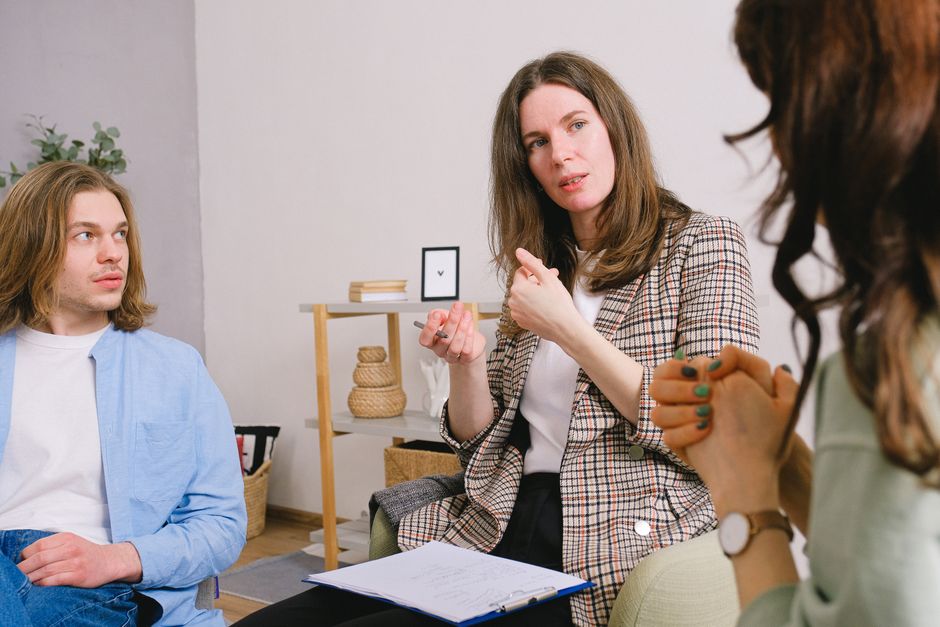
Photo: cottonbro studio via Pexels
This article is for general informational purposes only and does not constitute mental health, medical, or clinical advice. If you are in crisis or experiencing a mental health emergency, please contact the 988 Suicide and Crisis Lifeline (call or text 988) or go to your nearest emergency room. Always consult a licensed mental health professional for care specific to your needs.
Recommended Resources
Disclosure: As an Amazon Associate, we earn a small commission from qualifying purchases at no extra cost to you. We only recommend products that genuinely support the topics covered in this article.
- Feeling Good: The New Mood Therapy (~$14), The most clinically studied self-help book for depression, recommended by therapists worldwide as CBT-based self-treatment.
- Depression & Anxiety Therapy Journal (~$10), 8-week guided journal with trigger tracking and mood diary, mirrors the homework your therapist would assign between sessions.
- The Feeling Good Handbook (~$18), Practical workbook companion to Feeling Good, structured CBT exercises for depression, anxiety, and relationship problems.