 Dr. Chris Peterson
Most people picture exposure therapy as something close to torture. You’re afraid of spiders, so a therapist dumps a tarantula in your lap. Done. Cured. That version is wrong, and honestly, it’s one of the most damaging myths in mental health because it keeps people from accessing one of the most well-validated treatments we have.
I’ll be honest: when I first started working alongside clinical teams doing exposure-based work, I had reservations. Not about the theory, but about whether everyday people could actually tolerate the process well enough to benefit from it. What surprised me was how rarely the treatment looks like what people expect, and how often clients later describe it as less miserable than months of avoidance.
Exposure therapy is a behavioral intervention rooted in learning theory. The core idea is that fear, when confronted directly and repeatedly without the catastrophe materializing, loses its grip. Not overnight. Not painlessly. But genuinely, measurably, documentably.
- Exposure therapy is among the most research-backed treatments for anxiety disorders, OCD, PTSD, and specific phobias.
- It works by systematic, graduated confrontation of feared stimuli, not sudden overwhelming exposure.
- Treatment typically runs 8-15 sessions, though complex trauma cases often take longer.
- A trained therapist builds a "fear hierarchy" with you before any exposure begins, you're not thrown in the deep end.
- Avoidance is the fuel that keeps anxiety alive; exposure interrupts that cycle at the source.
What’s Actually Happening in Your Brain
Fear memory is sticky. When you experience something threatening, your amygdala encodes it fast and hard, and your nervous system builds in a shortcut: encounter the cue, trigger the alarm. Avoidance is the thing that makes this worse, not better, because you never give your brain the corrective experience it needs.
Exposure works through two overlapping mechanisms. The first is extinction learning: repeated contact with the feared stimulus, without the predicted bad outcome, weakens the conditioned fear response. The second, which has gotten a lot more attention in the past decade or so, is inhibitory learning, the idea popularized by Michelle Craske’s lab at UCLA. You’re not erasing the old fear memory. You’re creating a new, competing one. The brain now holds two possibilities: “this thing might be dangerous” and “I’ve survived this dozens of times.” With enough exposure trials, the latter starts winning.
The research here is genuinely strong. A meta-analysis published in Clinical Psychology Review found exposure-based treatments produced large effect sizes across anxiety disorders, with gains that held at follow-up. For specific phobias, some single-session intensive protocols produced clinically significant improvement in upward of 80-90% of participants. That’s not a small number.
The Fear Hierarchy: Where It Actually Starts
Helpful resource: Anxiety Relief Journal with CBT Prompts and Mood Tracker is a top-rated option for this. (As an Amazon Associate this site earns from qualifying purchases.)
Here’s what I got wrong for a long time: I assumed exposure therapy began with exposure. It doesn’t. The first two or three sessions are almost entirely assessment and construction of what clinicians call a fear hierarchy (or “SUDS hierarchy,” referring to Subjective Units of Distress, rated 0-100).
A therapist and client sit down and map out every fear-related situation, from mildly uncomfortable to intolerable. For someone with social anxiety, that might look like: imagining calling to make a restaurant reservation (SUDS: 30), actually making the call (55), attending a party where they know nobody (75), giving a toast at a wedding (95). Therapy then works through that hierarchy, usually from bottom to top, not jumping to the hardest items until lower ones are manageable.
One reader, Marcus, a teacher from Portland, described it to me this way: “I thought I’d be asked to do something terrifying in the first session. Instead my therapist spent an hour just asking me what I avoided on a Tuesday.” That slow start is intentional. It’s also where a lot of the trust-building happens.
The therapist doesn’t just design exposures. They also help you drop what are called “safety behaviors,” the subtle avoidance moves that feel like coping but actually prevent learning. Checking your phone constantly at a party. Standing near the exit. Rehearsing what you’ll say. These behaviors maintain the anxiety by preventing you from getting the full disconfirming experience.
Types of Exposure (It’s Not All Spiders)
How does therapy work? | BBC Ideas · BBC Ideas on YouTube
There are several distinct formats, and which one a therapist uses depends heavily on the presenting problem.
In vivo exposure means direct, real-world contact with the feared situation: driving on the highway, entering a crowded store, touching a doorknob without washing hands afterward.
Imaginal exposure uses vivid mental imagery or narrated scripts. It’s commonly used in PTSD treatment when in vivo exposure isn’t possible or appropriate, processing the memory of a car accident rather than re-staging one. Prolonged Exposure (PE), developed by Edna Foa at the University of Pennsylvania, relies heavily on imaginal work combined with in vivo.
Interoceptive exposure targets the physical sensations of anxiety themselves. For panic disorder, a therapist might have you spin in a chair, breathe through a coffee straw, or do jumping jacks, deliberately triggering dizziness or a racing heart, so you learn those sensations aren’t dangerous.
Virtual Reality Exposure Therapy (VRET) is worth mentioning here because it’s moved from experimental to genuinely available. As of July 2026, platforms like Oxford VR are being used in NHS-partnered programs in the UK, and several U.S. clinics have integrated VR for flight phobia, PTSD, and public speaking anxiety. It’s not yet widely accessible in standard outpatient settings, but it’s closer than most people realize.
Who It Helps (and Where It Gets Complicated)
These figures are rough averages drawn from APA clinical practice guidelines and published meta-analyses, and “response” definitions vary across studies, so treat them as directional rather than precise. The PTSD number in particular is complicated: dropout rates in trauma-focused exposure treatments run higher than in other protocols, often because revisiting traumatic material is genuinely hard. That’s not a flaw in the research; it’s a real clinical challenge.
Here’s a comparison of the main exposure-based treatment protocols, which I’ve found useful when people are trying to understand what their therapist is actually doing:
| Protocol | Primary Target | Format | Typical Length |
|---|---|---|---|
| Prolonged Exposure (PE) | PTSD | Imaginal + in vivo | 8-15 sessions |
| Exposure and Response Prevention (ERP) | OCD | In vivo, ritual blocking | 12-20 sessions |
| Cognitive Processing Therapy (CPT) | PTSD | Cognitive + some exposure | 12 sessions |
| One-Session Treatment (OST) | Specific phobias | Intensive in vivo | 1 session (2-3 hrs) |
| Unified Protocol (UP) | Mixed anxiety/depression | Multi-component exposure | 12-18 sessions |
| EMDR | PTSD | Trauma processing + exposure elements | 8-12 sessions |
One note on EMDR: the research debate on why it works continues, but its effectiveness for trauma is well-supported. Whether the bilateral stimulation does the work or whether it’s primarily an exposure mechanism in disguise is still a legitimate scientific argument.
Finding the Right Therapist
This is where I see people get stuck, sometimes for years. Knowing that exposure therapy exists doesn’t help if you can’t locate a competent provider. A few practical things I’d flag:
Look specifically for therapists trained in evidence-based protocols, not just “anxiety treatment.” The Psychology Today therapist directory lets you filter by specialty and treatment approach, and you can search for “exposure and response prevention” or “prolonged exposure” specifically. The National Alliance on Mental Illness (NAMI) also maintains a helpline (1-800-950-NAMI) staffed by people who can help you identify local resources, including low-cost options.
Cost varies dramatically. In major cities, a 50-minute session with a licensed psychologist currently runs $200-$350 without insurance. Community mental health centers might offer sliding scale fees as low as $20-$40. Telehealth platforms have genuinely expanded access, though the quality varies, and not every telehealth therapist is actually trained in structured exposure protocols. Ask directly: “Have you completed formal training in [ERP/PE/whatever you need]?” A trained clinician won’t be offended. One who gets defensive might be worth reconsidering.
If you want to do some preparation reading before starting, I’d recommend Overcoming Unwanted Intrusive Thoughts by Sally Winston or The Anxiety and Worry Workbook by Clark and Beck (both available on Amazon, and disclosure: this site may earn a commission on purchases made through links). These aren’t substitutes for therapy, but they can help you arrive informed and get more out of the work.
Sources
- Craske, M.G. et al. (2014): “Maximizing exposure therapy: An inhibitory learning approach.” Behaviour Research and Therapy, 58, 10-23.
- Foa, E.B. & Kozak, M.J. (1986): “Emotional processing of fear: Exposure to corrective information.” Psychological Bulletin, 99(1), 20-35.
- APA Clinical Practice Guideline for PTSD (2017, updated guidance 2023): Evidence review supporting exposure-based treatments.
- Wolitzky-Taylor, K.B. et al. (2008): “Psychological approaches in the treatment of specific phobias.” Clinical Psychology Review, 28(6), 1021-1037.
- National Alliance on Mental Illness (NAMI): Resource hub for finding evidence-based mental health treatment.
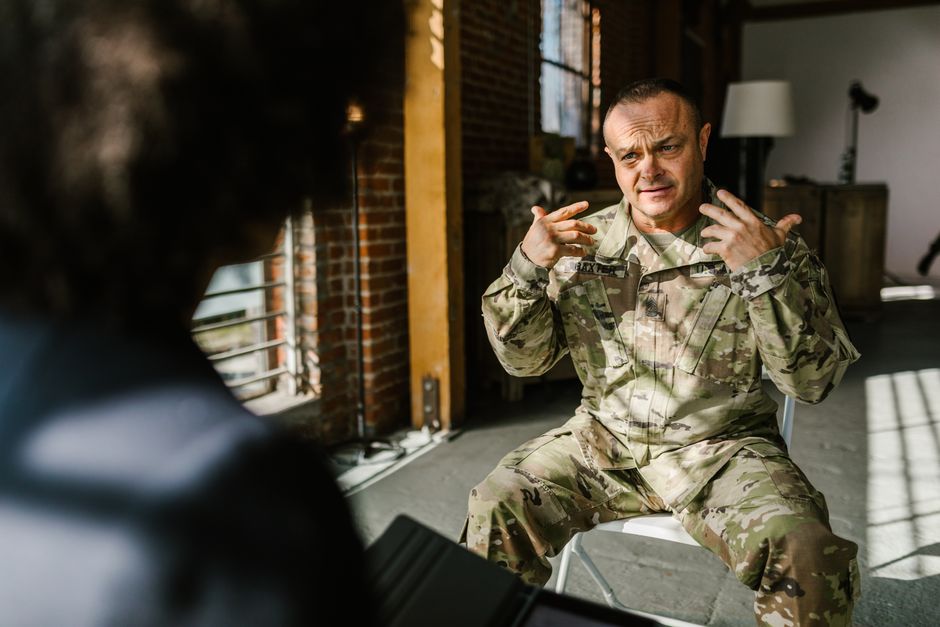
Photo: SHVETS production via Pexels
This article is for general informational purposes only and does not constitute mental health, medical, or clinical advice. If you are in crisis or experiencing a mental health emergency, please contact the 988 Suicide and Crisis Lifeline (call or text 988) or go to your nearest emergency room. Always consult a licensed mental health professional for care specific to your needs.
Recommended Resources
Disclosure: As an Amazon Associate, we earn a small commission from qualifying purchases at no extra cost to you. We only recommend products that genuinely support the topics covered in this article.
- Feeling Good: The New Mood Therapy (~$14), The most clinically studied self-help book for depression, recommended by therapists worldwide as CBT-based self-treatment.
- Depression & Anxiety Therapy Journal (~$10), 8-week guided journal with trigger tracking and mood diary, mirrors the homework your therapist would assign between sessions.