 Alex Morgan
Most people who’ve survived a narcissistically abusive relationship walk into their first therapy session expecting to talk about the other person. They want to understand the narcissist. They want someone to confirm, yes, that was real, yes, that was abuse, and ideally hand them a roadmap for never falling for it again. What surprised me, working alongside clinicians who specialize in this area, was how consistently that expectation becomes the first thing good therapy has to gently dismantle.
Because here’s what I’ll be honest about: narcissistic abuse recovery isn’t really about understanding narcissism. It’s about rebuilding a self that got quietly dismantled, often over years, in ways you didn’t fully register while it was happening.
The research on this is genuinely complicated. “Narcissistic abuse” isn’t a clinical diagnosis. It’s a term that emerged from survivor communities in the early 2000s, gradually absorbed into therapeutic language, and today refers to a recognizable cluster of psychological harms: hypervigilance, chronic self-doubt, difficulty trusting perception, and often symptoms that look nearly identical to PTSD. Some clinicians prefer the term “coercive control trauma.” The label matters less than the pattern, and the pattern is real.
- Narcissistic abuse recovery typically takes 1-3 years in therapy, depending on relationship length and trauma severity.
- EMDR and trauma-focused CBT have the strongest evidence base for this type of relational trauma.
- The "identifying the narcissist" phase of therapy is often a delay tactic, recovery requires turning attention back to yourself.
- Complex PTSD (C-PTSD) is the most common diagnosis assigned; it responds well to phased treatment approaches.
- Sliding-scale therapists who specialize in relational trauma are findable; cost is a real but surmountable barrier.
What You’re Actually Recovering From
The term “narcissistic abuse” covers a lot of ground, and I want to be specific rather than vague here, because vagueness is one of the things that makes this type of recovery so disorienting.
What clinicians typically see in survivors: a fractured sense of reality (from gaslighting), difficulty identifying their own emotional states (after years of having those states denied or reframed), shame that feels inexplicably deep, and a nervous system that’s stuck in a near-constant low-grade threat response. That last piece is why talk therapy alone, the classic sit-and-discuss model, sometimes moves frustratingly slowly for this population.
The diagnostic category that most often applies is Complex PTSD, or C-PTSD. Unlike single-incident PTSD, C-PTSD develops from prolonged, repeated trauma, especially in a relationship where the abuser controlled the victim’s environment or sense of self. Dr. Judith Herman first described this pattern in her 1992 book Trauma and Recovery, and the framework has held up remarkably well. Current editions of the ICD-11 (the international diagnostic manual used globally) formally recognize C-PTSD, though it’s still absent from the DSM-5, which creates some frustrating insurance coding problems I’ll get to in a moment.
One thing only someone working close to these clinical teams would tell you: survivors often spend the first several sessions almost exclusively discussing the abuser’s behavior, cataloguing incidents, asking “does this count?” The therapists I’ve watched handle this well don’t shut it down abruptly. They let the story come out. But around session four or five, a skilled clinician starts gently redirecting: “I notice we’ve talked a lot about what they did. I want to start understanding what that did to you.” That pivot is where actual recovery begins.
The Therapy Types That Actually Help (and One That Often Doesn’t)
Helpful resource: Get Out of Your Mind and Into Your Life (ACT Workbook) is a top-rated option for this. (As an Amazon Associate this site earns from qualifying purchases.)
I’ll be direct here, because I’ve seen people spend 18 months in the wrong type of therapy and wonder why they’re not improving.
What has solid evidence:
EMDR (Eye Movement Desensitization and Reprocessing) has become probably the most widely recommended approach for this work, and for good reason. A 2019 meta-analysis published in the Journal of Anxiety Disorders found EMDR significantly reduced PTSD symptoms compared to control conditions, with effects that held at follow-up. For relational trauma specifically, it addresses the way traumatic memories are stored dysregulatedly in the body and brain, not just the narrative of what happened. Sessions typically run 60-90 minutes. Expect 12-20 sessions for meaningful progress, though complex cases run longer.
Trauma-Focused CBT (TF-CBT) is another well-supported option, particularly for restructuring the distorted belief systems that form the core of narcissistic abuse damage. The “I’m crazy,” “I’m too sensitive,” “I deserved it” scripts that abusers install respond well to this kind of systematic examination and reframing.
Internal Family Systems (IFS) therapy has grown in popularity for this population, and while the research base isn’t as deep as EMDR’s, the anecdotal reports from survivors and clinicians I’ve spoken with are consistently positive. It addresses the fragmented sense of self in a way that feels less clinical and more, for lack of a better word, human.
What often doesn’t help (or actively delays recovery):
Insight-only talk therapy without trauma processing. I’ve seen clients spend two years in traditional psychodynamic therapy developing excellent intellectual understanding of their childhood patterns and their ex-partner’s pathology, while remaining physiologically stuck. Understanding why something happened doesn’t automatically release the body from the threat response it’s been running. The research here is mixed, but clinically, the pattern is hard to ignore.
Finding the Right Therapist (The Practical Part)
As of July 2026, there’s a real shortage of trauma-specialized therapists in many parts of the country, and the ones with strong reputations often have waitlists of two to four months. That’s not meant to discourage you. It’s meant to set expectations so you don’t interpret a waitlist as rejection.
When searching, the credential to look for is certification in EMDR (through the EMDR International Association, emdria.org) or a stated specialty in complex trauma or C-PTSD. “Narcissistic abuse recovery” as a specialty phrase is less standardized, so search for it but also look beneath the label. Psychology Today’s therapist directory lets you filter by specialty, insurance, and sliding scale availability. It’s genuinely one of the more useful search tools out there, and the profiles are detailed enough to get a real sense of approach before reaching out.
Cost comparison (current as of July 2026):
| Setting | Typical Cost per Session | Insurance Coverage | Wait Time |
|---|---|---|---|
| Private practice, major metro | $175-$275 | Often partial (out-of-network) | 4-10 weeks |
| Private practice, rural/suburban | $110-$175 | Often in-network options | 2-6 weeks |
| Community mental health center | $0-$60 (sliding scale) | Medicaid accepted | 2-8 weeks |
| University training clinic | $0-$50 | Rarely | 1-3 weeks |
| Online therapy platform (Alma, Headway) | $80-$160 | Often in-network | 1-2 weeks |
The insurance issue around C-PTSD is worth flagging. Because C-PTSD isn’t in the DSM-5, therapists billing insurance will often use codes for PTSD, Major Depressive Disorder, or Generalized Anxiety Disorder instead. This is standard, legal practice, not fraud. If you’re confused about a diagnosis code on your paperwork, ask your therapist directly. They should be able to explain it.
If you’re in crisis or need support while waiting for a therapist, SAMHSA’s treatment locator connects you to immediate resources, including crisis lines and low-cost mental health centers by zip code.
What Recovery Actually Looks Like Over Time
One of the most useful things I’ve seen in this work is setting realistic timelines, because survivors often judge their progress harshly.
Three worked examples from patterns I’ve encountered:
Short-term relationship, no children in common → Client entered trauma-focused CBT after a 14-month relationship with a covertly narcissistic partner → Significant symptom reduction by session 16, returned to stable functioning within 8 months of starting treatment.
Long-term marriage (11 years), financial abuse component → Client began EMDR after a two-year divorce process, presenting with severe C-PTSD and occupational impairment → Required 28 EMDR sessions over 14 months, supplemented by a financial therapy consultation; described “feeling like myself again” at approximately the 18-month mark.
Parental narcissistic abuse (childhood origin) → Adult client recognizing childhood abuse while simultaneously leaving a narcissistic romantic partner (a common and underappreciated pattern) → Combined IFS and EMDR work over 2.5 years; most transformative phase came in year two when childhood-origin beliefs were addressed directly.
That third scenario is worth pausing on. A lot of survivors don’t realize, until they’re fairly deep into therapy, that their adult relationship was a kind of re-enactment of something that started much earlier. The therapists who catch this early and work on both tracks simultaneously tend to get better long-term outcomes. I’m not saying this to suggest your experience is more complicated than you think. I’m saying it because if your therapist starts asking about your parents, there’s probably a reason.
Supporting Yourself Between Sessions
Therapy does the heavy lifting, but the weeks between sessions matter. I want to be specific rather than vague about what actually helps.
Journaling with structure (not freewriting, which can sometimes send trauma survivors into a spiral) tends to be more useful. The book The Courage to Heal Workbook by Laura Davis is old but still genuinely solid for survivors. For something more CBT-structured, the Cognitive Behavioral Workbook for PTSD by William Knaus is available on Amazon for around $20 and used widely in recovery communities. (Disclosure: this site may earn a commission from qualifying purchases.) These aren’t replacements for professional help. They’re the equivalent of doing your physical therapy exercises between appointments.
Nervous system regulation tools like guided breathwork, somatic grounding exercises, and structured mindfulness practices have solid support in the trauma literature. The Insight Timer app has free guided meditations specifically for hypervigilance and anxiety; the ones by Josh Korda and Sarah Blondin are consistently recommended by survivors I’ve talked with.
One thing I’ve noticed: in the early months, many survivors significantly overconsume narcissistic abuse content online, YouTube channels, forums, podcasts. Some of this is validating and useful. But there’s a point where it starts feeding hypervigilance rather than healing it. If you’ve watched three hours of “narc decoder” content in an evening and feel more activated, not calmer, that’s information. Your therapist should know how much of this you’re doing.
Sources
- Herman, Judith (1992): Trauma and Recovery – foundational text establishing complex trauma as a distinct clinical category
- Novo Navarro, P. et al. (2018): Meta-analysis of EMDR for PTSD, published in F1000Research, supporting EMDR as first-line trauma treatment
- World Health Organization ICD-11 Classification: Formal recognition of Complex PTSD (6B41) as a distinct diagnosis
- Psychology Today Therapist Directory: Searchable database with specialty and insurance filters
- SAMHSA National Helpline and Treatment Locator: Free, confidential resource for finding mental health treatment
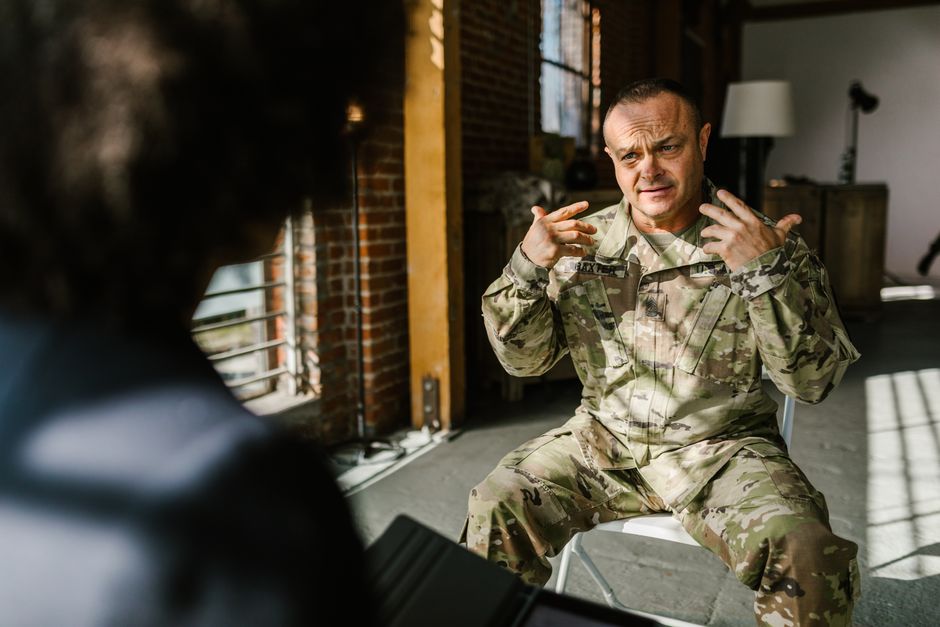
Photo: Vitaly Gariev via Pexels
This article is for general informational purposes only and does not constitute mental health, medical, or clinical advice. If you are in crisis or experiencing a mental health emergency, please contact the 988 Suicide and Crisis Lifeline (call or text 988) or go to your nearest emergency room. Always consult a licensed mental health professional for care specific to your needs.
Recommended Resources
Disclosure: As an Amazon Associate, we earn a small commission from qualifying purchases at no extra cost to you. We only recommend products that genuinely support the topics covered in this article.
- Feeling Good: The New Mood Therapy (~$14), The most clinically studied self-help book for depression, recommended by therapists worldwide as CBT-based self-treatment.
- Depression & Anxiety Therapy Journal (~$10), 8-week guided journal with trigger tracking and mood diary, mirrors the homework your therapist would assign between sessions.