 Taylor Brooks
Something significant happened in federal mental health policy on July 13, 2026, and if you work with veterans, it changes the questions your clients will start asking you, possibly very soon. The Department of Health and Human Services and the Department of Veterans Affairs signed a five-year Memorandum of Understanding to coordinate clinical trials, workforce training, and data-sharing specifically for psychedelic drug therapies targeting veterans with serious mental illness. The same day, the FDA released its final industry guidance titled “Psychedelic Drugs: Considerations for Clinical Investigations.” Both of these things happened at once, which is not an accident. This is a coordinated federal signal, and therapists who work with veterans, or who plan to, need to understand what’s actually in this agreement and, equally important, what isn’t.
What surprised me, digging into the details, is how carefully the MOU threads a needle between scientific urgency and regulatory caution. The agreement explicitly states that clinical use outside of research settings will only happen after FDA approval. Experts quoted in coverage from Military Times and Forbes have been consistent on this: we’re talking about a timeline measured in years, not months. So this isn’t a green light for practice. It’s the beginning of a structured federal commitment that will eventually reshape the field, but not tomorrow.
- The VA-HHS MOU signed July 13, 2026, covers five years of coordinated psychedelic research, training, and data-sharing.
- Clinical use outside research is explicitly prohibited until FDA approval, which experts say is years away.
- The VA already has 20 active psychedelic therapy trials backed by over $23 million in external funding.
- NIDA awarded $2.3 million specifically toward an ibogaine IND application as of July 2026.
- A RAND study found roughly half of veterans support VA-provided psilocybin or MDMA therapy if FDA-approved.
Why Ibogaine Is the Name You Should Know Right Now
MDMA and psilocybin have dominated psychedelic therapy conversations for years. I’ll be honest: I assumed they’d continue to lead the federal agenda. But Executive Order 14401, signed by the president on April 18, 2026, specifically named ibogaine as the “next big one,” and that framing has stuck in the policy world. NIDA has already awarded $2.3 million to support an Investigational New Drug application for ibogaine, and ARPA-H has opened competitive funding for ibogaine research targeting opioid use disorder specifically.
Why ibogaine? The veteran population context matters here. Veterans face compounding crises: PTSD, TBI, depression, and opioid use disorder often exist together in the same person. Ibogaine, a naturally occurring psychoactive compound derived from the iboga plant, has shown early promise for opioid use disorder in international research settings, but it also carries cardiac risks that make rigorous clinical infrastructure non-negotiable. The federal emphasis on ibogaine isn’t impulsive. It reflects the gap between what conventional pharmacology handles and what this population actually needs.
Therapists working in substance use treatment especially need to track this. Ibogaine research is moving faster than most practitioners realize, and your clients may be reading about it, or already seeking it informally outside the country.
What the VA’s Current Trial Footprint Actually Looks Like
Helpful resource: Aura Smart Sleep and Meditation Lamp is a top-rated option for this. (As an Amazon Associate this site earns from qualifying purchases.)
Before this MOU, the VA wasn’t standing still. The numbers are worth putting side by side, because the scale is larger than most people outside VA system know.
| Metric | Current Figure |
|---|---|
| Active VA psychedelic therapy trials | 20 |
| External funding supporting those trials | $23+ million |
| Veterans estimated to have used psychedelics | 4.8 million (RAND) |
| Veterans supporting VA psilocybin/MDMA therapy (if FDA-approved) | ~50% (RAND) |
| NIDA ibogaine IND funding awarded | $2.3 million |
| MOU duration | 5 years (2026-2031) |
The RAND figure of 4.8 million veterans who have already used psychedelic drugs is the one that stopped me. That’s not a fringe population experimenting at the margins. That’s a massive portion of the veteran community that has, in many cases, self-medicated or sought treatment through underground or international channels precisely because clinical options didn’t exist domestically. Half of veterans supporting formal VA access if FDA-approved is a high number. These clients aren’t waiting for policy to catch up to their reality. Many of them are already in your office, just not telling you everything.
What the FDA Guidance Actually Means for Clinical Practice
The FDA’s final guidance released July 13, 2026, titled “Psychedelic Drugs: Considerations for Clinical Investigations,” is a document aimed at researchers and sponsors, not practicing therapists. But it matters for practitioners in a few specific ways.
It signals that the FDA has moved from treating psychedelic research as a fringe regulatory problem to treating it as a legitimate, structured clinical domain with defined expectations. The guidance clarifies how sponsors should handle the unusual features of psychedelic trials: the impossibility of true blinding, the integration of psychotherapy components, safety monitoring for drugs with cardiac or psychological risk profiles. The FDA also announced a public hearing on therapeutic psychedelics, which means the formal deliberation process, the one that precedes any approval, is now underway.
For therapists, the practical implication is this: the training requirements that will govern any eventual approved protocol will be shaped during the window we’re in right now. Comments submitted to the FDA, research designs funded through ARPA-H, and workforce training frameworks developed through the MOU are all forming simultaneously. Therapists who get involved in trial settings, or who at minimum engage with professional organizations tracking this, will be better positioned when standards do crystallize.
The Training Gap Nobody Is Fully Prepared For
I’ll be honest about where the uncertainty sits. The MOU directs the VA and HHS to coordinate on workforce training, but the specific credentialing frameworks for psychedelic-assisted therapy don’t exist yet at the federal level. What we do have are private training programs, some rigorous and some not, that have been filling the gap. Organizations like MAPS have developed facilitator training curricula, and institutions like CIIS have academic programs underway. But none of these map directly onto what a VA-credentialed psychedelic therapist might eventually look like.
What this means practically: if you’re curious about this area, the appropriate move right now is to stay connected to your professional association’s communications about the federal process, consider observer or research-adjacent roles in trial settings if you have access, and approach continuing education in this space with healthy skepticism about any program that claims to fully credential you for something that isn’t yet clinically approved.
The clients who will benefit from these treatments are real people dealing with real, severe suffering. The research is genuinely promising, the federal commitment is real, and the caution about timelines is equally real. None of that is contradictory. It’s just where the field actually is.
As the MOU’s five-year framework takes shape through 2031, the therapists who will serve this population best are the ones who stay informed, stay grounded in what current licensure and ethics actually permit, and treat their veteran clients’ questions about psychedelic therapy with curiosity rather than dismissal or unchecked enthusiasm. Both of those responses miss the mark. The honest answer, right now, is: “This is real, it’s moving, and here’s what we actually know.”
Sources
- HHS & VA Announce Bold, Comprehensive Partnership to Advance Rapid-Acting Mental Health Treatments for Veterans (July 13, 2026)
- VA, HHS to increase psychedelic therapy research for PTSD, military-related mental health issues (July 14, 2026)
- Federal Agencies Unite On Psychedelic Trials For Veterans (July 14, 2026)
- VA, HHS sign MOU to improve cooperation on psychedelic drug trials (July 13, 2026)
- Federal Health Officials And VA Launch Psychedelic Research Partnership (July 13, 2026)
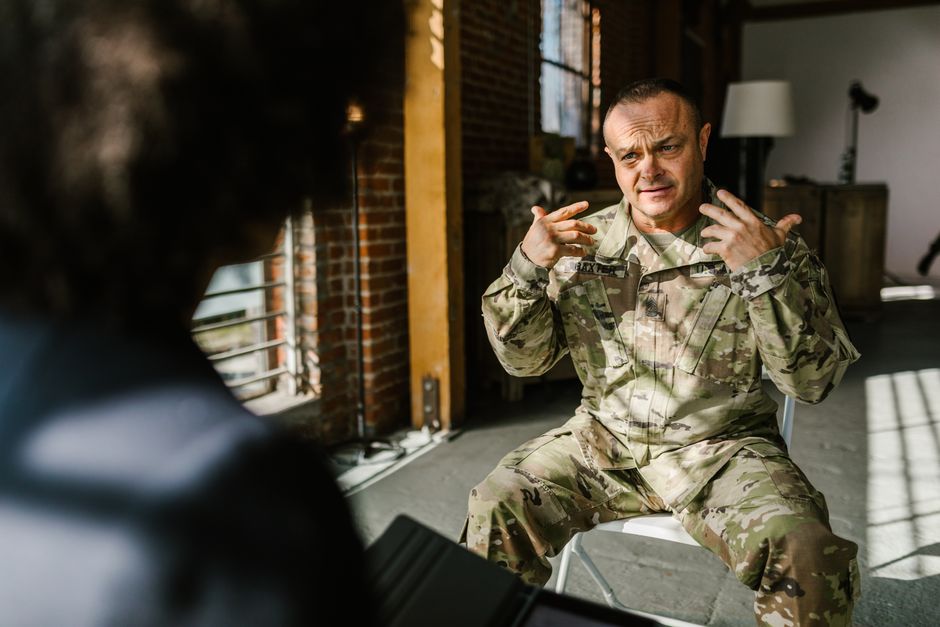
Photo: RDNE Stock project via Pexels
This article is for general informational purposes only and does not constitute mental health, medical, or clinical advice. If you are in crisis or experiencing a mental health emergency, please contact the 988 Suicide and Crisis Lifeline (call or text 988) or go to your nearest emergency room. Always consult a licensed mental health professional for care specific to your needs.
Recommended Resources
Disclosure: As an Amazon Associate, we earn a small commission from qualifying purchases at no extra cost to you. We only recommend products that genuinely support the topics covered in this article.
- Feeling Good: The New Mood Therapy (~$14), The most clinically studied self-help book for depression, recommended by therapists worldwide as CBT-based self-treatment.
- Depression & Anxiety Therapy Journal (~$10), 8-week guided journal with trigger tracking and mood diary, mirrors the homework your therapist would assign between sessions.